
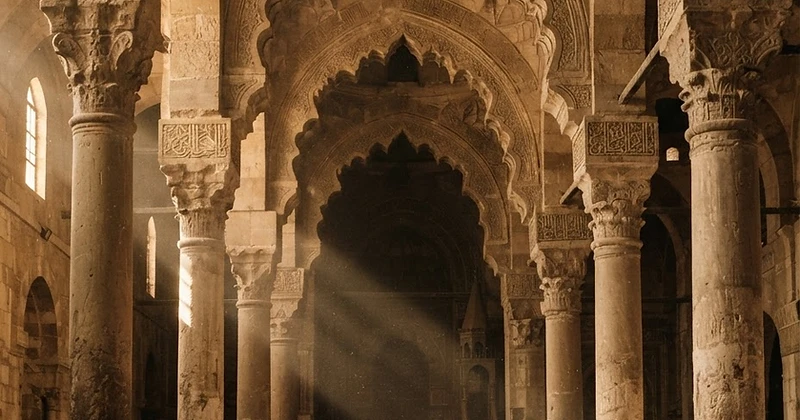
Gaza's heritage is among the oldest and most layered on the Mediterranean. Archaeological evidence traces continuous settlement back more than five thousand years, placing the city at the very dawn of Levantine civilization. Its position on the Via Maris — the ancient coastal highway linking Egypt to the Fertile Crescent — made Gaza a natural crossroads where armies, merchants, pilgrims, and scholars converged, each leaving a stratum of culture upon the last.
The old city preserves a dense fabric of mosques, churches, caravanserais, and courtyard homes. The Great Omari Mosque rises on foundations that have shifted from Canaanite temple to Byzantine church to Islamic house of prayer, a single site embodying the city's religious continuity. Nearby, the Gold Market and the Samra Quarter recall a time when Gaza was the southern anchor of the Palestinian coast, its port exporting grain, soap, and the celebrated Gaza wine across the Mediterranean.
Beyond its monuments, Gaza's heritage lives in its crafts: the keffiyeh woven in olive and gold, the embroidery stitched with motifs of cypress and orange, and the clay vessels thrown on wheels that have scarcely changed since the Byzantine era. These traditions are carried not by stone alone but by families, by songs, by recipes, and by a diaspora that has carried Gaza's name to nearly every continent.
I Love Gaza exists to keep this heritage legible to the world. Our Living Archive, our Global Directory, and our Souq are three windows onto a single inheritance: a city older than memory, still writing its next chapter. We invite you to explore, to remember, and to participate.